
For years, automotive digital marketing revolved around a familiar path: a shopper searched Google for Chevy dealer near me, used Tahoe Cleveland or best lease deals Silverado, then clicked an organic result, a paid ad or a marketplace listing.
That model still matters. But a growing share of vehicle research now starts with a much richer question:
“I need a three-row SUV under $50,000 with good reliability, enough room for three kids and decent towing capacity. What should I look at?”
That is not a keyword. It is a buying conversation. And dealerships need a strategy for being visible inside it.
THE AUTOMOTIVE SEARCH SHIFT
Car shoppers are changing faster than dealership marketing plans.
Cox Automotive’s 2026 AI in Auto Retail Tracker found that 63% of in-market shoppers say they definitely or probably will use AI during their next vehicle purchase. AI tools are already used as a vehicle-research channel by 36% of shoppers, nearly even with automotive-specific websites at 38%. Source: Cox Automotive AI in Auto Retail Tracker.
Yet Cox also reported that only 29% of dealers say they have begun adapting to AI-powered search. That creates a temporary gap between how consumers research and how many dealerships are structuring content, attribution and paid media.
The customer may be evolving faster than the dealership’s marketing strategy.
FROM ZERO TO A REAL CHANNEL
AI referral traffic did not exist a few years ago. Now dealers can measure it.
A few years ago, there was effectively no chatgpt.com / referral line in dealership analytics. Today there is.
Fullpath reported that dealership website traffic originating from ChatGPT, Gemini, Perplexity, Claude and other generative-AI platforms increased more than 15× year over year across its dealership network, with ChatGPT representing the large majority of those referrals in its January 2026 data. Source: Fullpath Auto Intelligence Index.
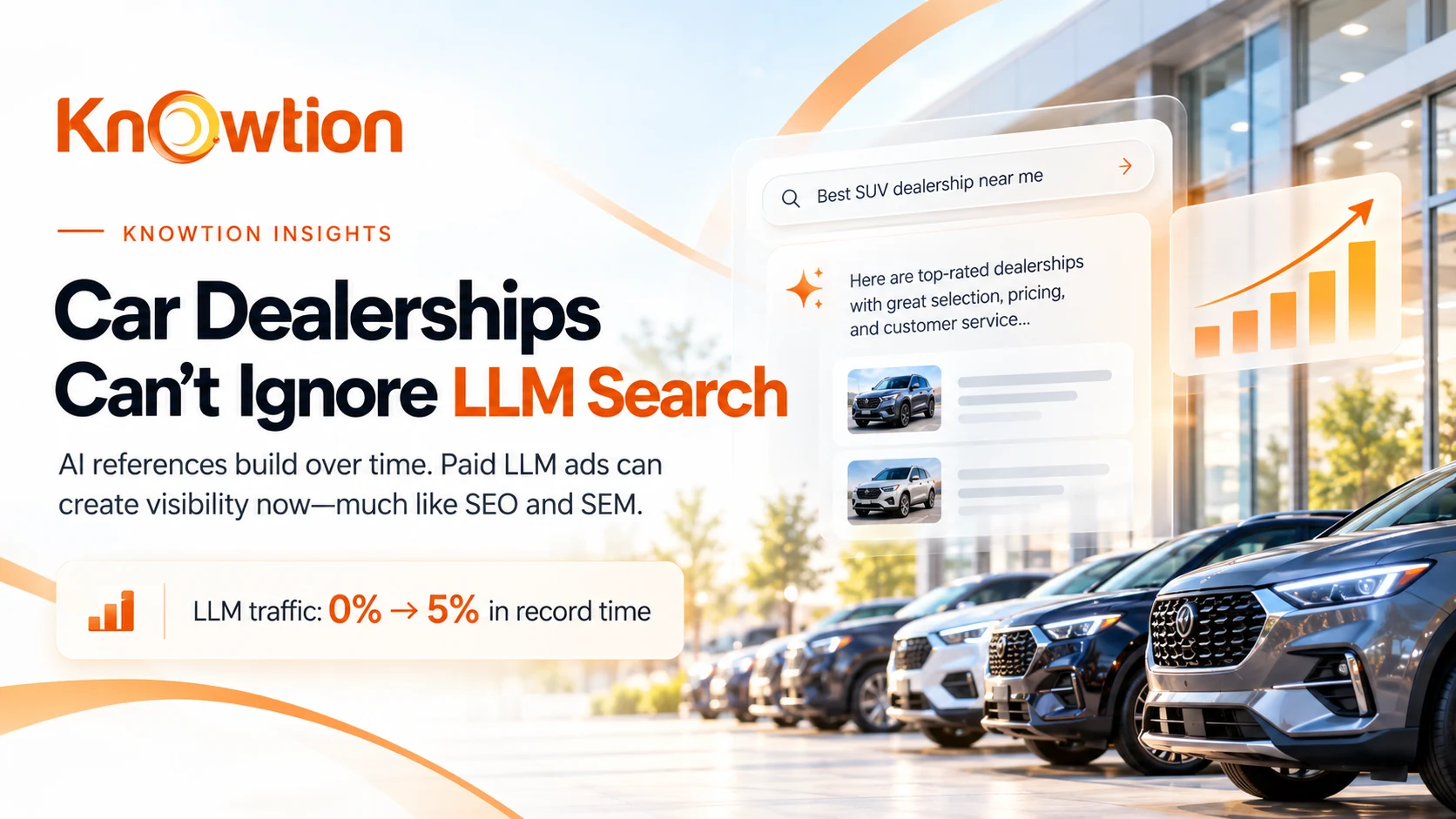
Current automotive benchmarks still put average AI-referral share in the low single digits, so 5% is not an industry-wide average today. The useful point is the trajectory: a channel that started at effectively zero is becoming measurable quickly. For an individual dealer or dealer group, the progression worth watching is:
And direct referral traffic probably understates AI’s influence. A shopper may ask ChatGPT which SUVs to consider, then later Google a dealership by name. GA4 may credit Google or Direct even though AI helped create the consideration.
KEYWORDS VS. CONVERSATIONS
The old game was ranking for phrases. The new game includes understanding the full buying context.
Dealership marketing teams know how to build around searches such as Ford dealer Cleveland, used cars near me, Silverado lease or Honda service near me.
Conversational search lets the shopper describe the whole problem instead:
“My wife drives mostly around town but we take four long trips a year. We have two kids and a large dog. I want a third row but not something as large as a Suburban. Budget is around $45,000 and I’d prefer AWD. What should we consider?”
There may never be meaningful monthly keyword volume for that exact sentence. But the shopper can still be highly qualified.
GOOGLE IS CHANGING TOO
Search engines increasingly answer the question before they send the click.
This is not simply ChatGPT taking searches away from Google. Google itself is becoming more conversational through AI Overviews and AI Mode.
Recent zero-click research found that a large majority of U.S. Google searches can end without a click to the open web. Source: Search Engine Land summary of 2026 zero-click research.
For dealerships, that means ranking remains important—but a ranking no longer guarantees the same volume of site traffic it once did. Visibility can happen on the search-results page, inside an AI answer, in a marketplace, in a map result or later through a branded search.
YOUR WEBSITE HAS A NEW AUDIENCE
A dealership website must now be understandable to shoppers, search engines and AI systems.
AI systems need clear information about which brands you sell, where you are located, what inventory you carry, whether you sell new or used vehicles, what service capabilities you have, how financing and trade-ins work, and why the store is credible.
Stronger: “Our dealership serves new and used Chevrolet shoppers across Cleveland’s eastern suburbs, with new vehicle sales, certified pre-owned inventory, financing, trade-in services, parts and Chevrolet service.”
The second version gives both a person and a machine concrete facts to work with.
This is why the future of dealership SEO is likely to include more decision-oriented content: model comparisons, towing guidance, lease-vs.-buy questions, CPO education, trade-in strategy, ownership cost and local vehicle-use questions—not just another page repeating “used SUVs near me.”
ORGANIC AI + PAID AI
Earn the recommendation over time. Buy the opportunity while you build it.
There are really two different AI-search strategies for dealerships.
| Traditional search | AI / conversational discovery |
|---|---|
| SEO Build authority, useful content, links, reviews and technical strength so Google chooses to rank you. | Organic AI visibility / GEO Build the information, reputation, proof and content that make AI systems more likely to understand, cite and recommend the dealership. |
| SEM / Google Ads Pay to appear immediately while organic rankings develop. | Paid AI advertising Use platforms such as ChatGPT Ads to test paid visibility in relevant conversational contexts while organic AI authority develops. |
Getting organically referenced by AI can be extremely valuable, but there is no switch labeled “make ChatGPT recommend my dealership.” Organic visibility is earned. It takes time, credible third-party signals, useful content and strong entity information.
Paid AI advertising closes part of that timing gap. OpenAI’s ChatGPT Ads platform lets advertisers build campaigns around views, clicks and conversions and use context hints to describe relevant conversations or needs. Those context hints are not exact-match keywords and do not guarantee placement. Source: OpenAI Ads.
Buying an ad also does not buy an organic recommendation. Ads are separate from ChatGPT’s answers. That makes the best dealership strategy similar to the SEO/SEM model marketers already understand:
Knowtion’s ChatGPT Ads for Car Dealerships offering is built around that idea: use a measured paid pilot to learn now while the dealership continues building long-term AI-search visibility.
WHY EARLY PAID TESTING MATTERS
The advantage is not just near-term leads. It is learning before the channel gets crowded.
A dealership testing paid conversational advertising now can begin building an operating history around:
Which conversational themes create engagement?
Which vehicle categories generate response?
Which creative messages work best?
Which landing pages convert?
What does cost per click look like?
What does cost per lead look like?
How does AI-assisted traffic behave after the click?
How should leads flow into CRM attribution?
That learning can compound. The long-term advantage in Google Ads was never simply knowing the platform existed—it was accumulating years of campaign data, conversion history, landing-page learning and operational experience.
AI advertising may follow a similar path.
WHAT DEALERS SHOULD DO NOW
Start measuring and learning before AI becomes another commodity channel.
THE DEALERSHIP QUESTION
When your next customer asks AI what vehicle to buy and where to buy it, will your dealership be part of the answer?
Organic AI visibility gives dealerships the opportunity to earn that recommendation over time.
Paid AI advertising gives them an opportunity to show up while they are building it.
Just as successful dealerships did not choose between SEO and paid search, the next generation of automotive marketing probably will not choose between organic AI visibility and paid conversational advertising.
AI SEARCH + PAID AI
Your shoppers are already learning new ways to search. Start learning faster than your competitors.
Knowtion can help your dealership measure AI visibility, strengthen content for conversational search and test paid ChatGPT Ads with clear conversion tracking.
FREQUENTLY ASKED QUESTIONS
AI search, automotive SEO and ChatGPT Ads
Are car shoppers really using ChatGPT and AI to research vehicles?
Yes. Cox Automotive reported in 2026 that 63% of in-market shoppers said they definitely or probably would use AI during their next vehicle purchase, and 36% were already using AI tools as a vehicle-research channel.
Is AI referral traffic already a major source of dealership website traffic?
It is growing quickly but is still a low-single-digit traffic source for many dealerships. The important signal is the rate of growth: Fullpath reported dealership AI referrals increasing more than 15 times year over year across its network.
What is the difference between automotive SEO and AI search optimization?
Traditional SEO focuses heavily on rankings and clicks from search engines. AI search optimization adds another objective: making the dealership, its expertise and its inventory or services easy for conversational AI systems to understand, cite and recommend. The two disciplines overlap heavily.
Can a dealership pay ChatGPT to recommend it organically?
No. Paid ChatGPT Ads are separate from ChatGPT’s organic answers. Advertising can create paid visibility in relevant conversational contexts, but it does not purchase an organic recommendation from the model.
Should dealerships move Google Ads budget into ChatGPT Ads?
Not wholesale. Google still captures important bottom-of-funnel automotive intent. A better early strategy is to treat paid AI as an incremental test with a defined budget, conversion tracking and learning goals while continuing to invest in proven search channels.
Why combine organic AI visibility with paid AI advertising?
Organic AI visibility can compound over time but cannot be switched on instantly. Paid AI advertising provides a more direct way to test visibility, creative, landing pages and conversion economics while the dealership builds long-term authority. It is similar to using SEM while SEO develops.
How should a dealership measure AI marketing performance?
Track AI referrals in GA4, branded-search changes, calls, form leads, CRM source data, assisted conversions and paid campaign results. Because AI can influence a shopper before the final click, last-click attribution alone will miss part of the journey.