
IT OPERATIONS & CYBERSECURITY
Switching managed service providers should be a business decision, not an emotional reaction to one bad ticket. The right time to evaluate a new MSP is when underperformance becomes structural—especially when two or more areas such as response, cybersecurity, strategic guidance, transparency, scalability or business fit remain consistently weak.
Changing IT providers can feel risky. Your managed service provider may hold administrative credentials, manage Microsoft 365, maintain backups, support employees, operate security tools and coordinate with critical vendors. That dependency is exactly why many organizations tolerate a weak MSP relationship longer than they should. If you are comparing what a modern relationship should include, review Knowtion’s Managed IT & Cybersecurity model alongside the warning signs below.
In 2026, the standard for managed IT is rising. Verizon’s 2026 Data Breach Investigations Report analyzed more than 31,000 security incidents and 22,000 confirmed breaches across 145 countries. It found that software vulnerability exploitation is now the leading initial-access vector at 31%, while ransomware appears in 48% of breaches. Third-party involvement also rose sharply, accounting for 48% of breaches. Source: Verizon 2026 DBIR.
That changes the MSP conversation. The question is no longer simply, “Does our IT company answer the phone?” It is:
Does our technology partner reduce risk, improve performance, create visibility and help the business move forward?
WHEN SERVICE FRICTION BECOMES STRUCTURAL
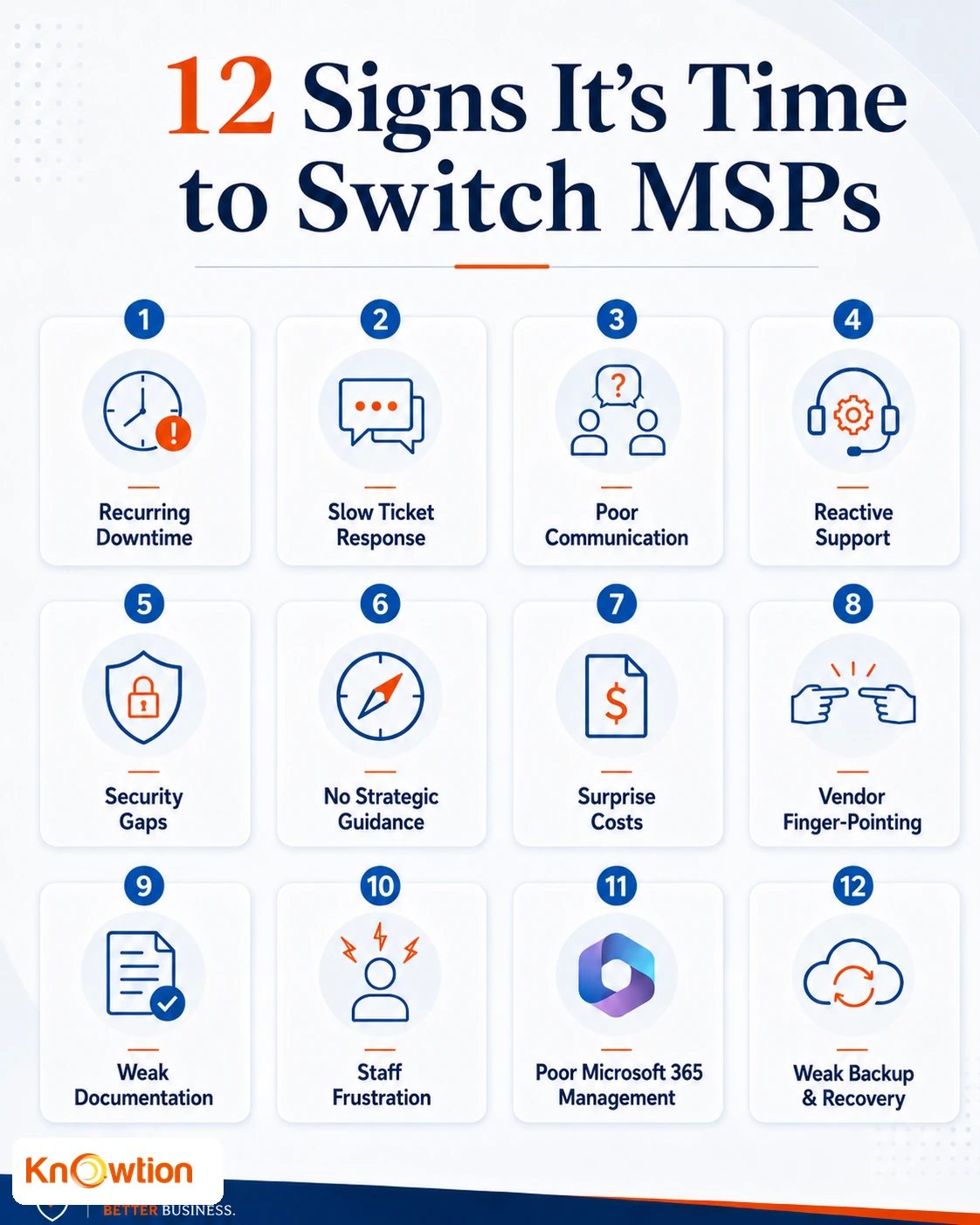
12 signs it may be time to switch MSPs
Recurring downtime has become normal
Every environment has occasional outages. The warning sign is the same outage repeating because the root cause is never removed. A mature MSP should use monitoring, trend analysis and lifecycle planning to reduce recurring incidents—not simply get efficient at closing them.
Ticket response is slow when the issue matters
A printer request and a production outage should not receive the same treatment. Ask how the MSP defines Priority 1 issues, who is alerted, when escalation occurs and what happens after hours. If severity and escalation are vague, the SLA may be more marketing language than operating discipline.
Communication gets worse when the stakes get higher
During an outage, leadership should not have to repeatedly ask what happened, who owns it, what the business impact is and when the next update will arrive. Technical skill without calm, proactive communication creates unnecessary operational anxiety.
Your MSP is reactive instead of proactive
If your team is always discovering the failed backup, expired firewall, unused license or unmanaged endpoint before the MSP does, you are still operating a break/fix model under a monthly contract. Managed IT should increasingly mean fewer surprises.
You cannot clearly explain your cybersecurity posture
Your provider should be able to show—not merely assert—how endpoints are protected, MFA is enforced, vulnerabilities are managed, privileged access is controlled and backups are protected. Verizon’s 2026 finding that vulnerability exploitation now leads initial access makes measurable patching and vulnerability management especially important.
There is no technology roadmap
A roadmap does not need to be a 70-slide deck. It should show what is aging, what creates risk, what should change next, expected timing and budget implications. Without it, IT spending becomes a sequence of emergencies instead of an operating plan.
IT costs continually surprise you
Projects and hardware can legitimately sit outside a managed-services fee. The problem is unpredictability: unexplained licenses, duplicate security tools, emergency hardware and projects that were never forecast. Your MSP should help make total technology cost more visible over the next 12–24 months.
Your MSP constantly points at other vendors
No MSP owns every ERP, CRM, phone system or vertical application. But someone still has to own the problem across vendors. “Call your ERP company” is not the same as coordinating the issue, providing the needed technical evidence and staying engaged until ownership is clear.
Documentation lives in one technician’s head
If your primary technician disappeared tomorrow, could another engineer identify the network, admin accounts, backup design, vendors, licensing, device inventory and critical workflows? Documentation is not administrative overhead. It is continuity, security and transition readiness.
Employees avoid contacting IT
When users say “I’ll just live with it” or turn managers into unofficial Tier 1 support, the business is absorbing invisible productivity loss. End-user sentiment is a legitimate operational KPI because technology friction compounds across every employee and every day.
Microsoft 365 is managed like email licensing
Microsoft 365 Business Premium can include full Intune capabilities, Microsoft Entra ID P1 and Defender for Business—not just email and Office apps. Microsoft confirms these capabilities. A modern MSP should understand identity, endpoints, offboarding, conditional access, licensing and governance as one operating environment.
You do not trust your backups—or have never tested recovery
A green backup dashboard does not prove recoverability. CISA recommends treating MSPs as part of ransomware and third-party risk management, including least-privilege access and appropriate backup protections. Source: CISA #StopRansomware Guide.
2026 MSP MARKET
The MSP market is changing—and your expectations should too
MSPs themselves are becoming more operationally mature. Service Leadership’s 2026 industry benchmark reported that managed service provider revenue growth rebounded to 9.6%, while adjusted EBITDA dollars grew 17.1%. It attributes the next phase of the market to efficiency, scale, automation and AI-enabled operations. Source: Service Leadership / ConnectWise, June 2026.
That last number matters when you outsource critical IT. An MSP is not just a help desk; it is part of your technology supply chain. CISA’s guidance for MSP customers recommends defining provider privileges in advance, using least privilege, validating MSP activity logs, maintaining offsite backups and including critical providers in incident-response and continuity planning. Source: CISA, Risk Considerations for MSP Customers.
The emerging standard is therefore much broader than patching and remote support: visibility + cybersecurity + automation + strategic guidance + accountable execution.
DON’T SWITCH ON EMOTION
Should you switch MSPs—or fix the current relationship?
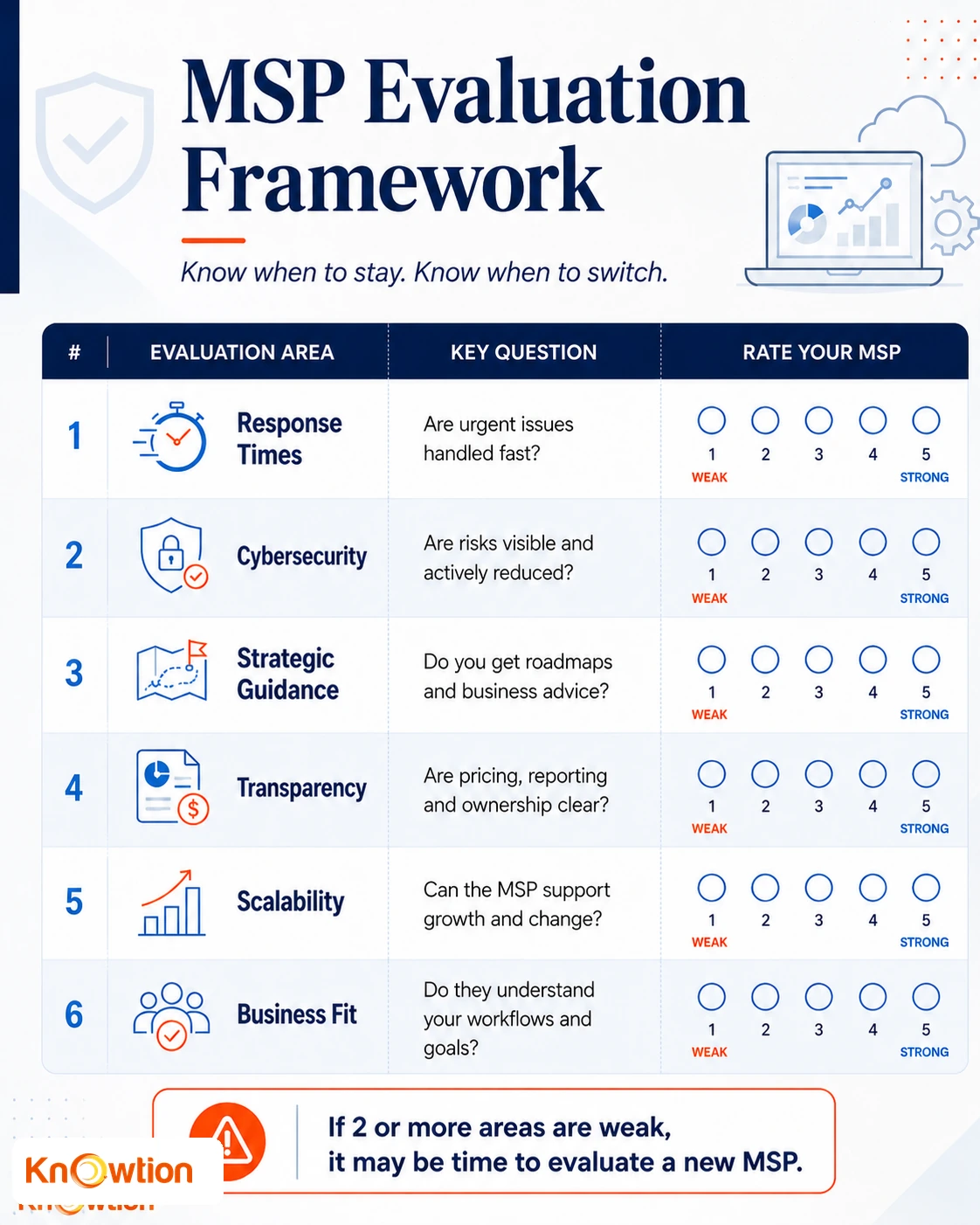
Not every disappointing relationship requires replacement. If the technical fundamentals are sound and leadership is engaged, expectations may be repairable. Start by rating your provider in six areas:
| Evaluation area | Question to ask | Strong evidence |
|---|---|---|
| Response | Are urgent issues handled at business speed? | Severity definitions, escalation path, response reporting |
| Cybersecurity | Are risks visible and continuously reduced? | MFA, EDR, vulnerability data, privileged-access controls |
| Strategy | Do we receive useful technology planning? | 12–24 month roadmap tied to business priorities |
| Transparency | Are cost, ownership and performance clear? | Reporting, asset inventory, licensing and budget visibility |
| Scalability | Can the provider support where we’re going? | Multi-site support, mature tools, specialist capacity |
| Business fit | Do they understand how we actually operate? | Vendor coordination, workflow context, executive guidance |
TRANSITION WITHOUT CREATING MORE RISK
How to switch MSPs without disrupting the business
The worst transition plan is terminating the old provider on Friday and asking the new provider to reverse-engineer everything Monday morning. A strong MSP transition is controlled and evidence-based.
- Inventory.Identify hardware, users, cloud systems, networks, domains, vendors, licenses and critical applications.
- Verify ownership and access.Confirm your organization controls domains, tenants, cloud accounts, licenses and administrative credentials.
- Collect documentation.Transfer diagrams, configurations, policies, warranty data, vendor contacts and support procedures.
- Review security access.Identify privileged accounts, VPNs, RMM agents, remote access tools and third-party connections.
- Validate backups before change.Confirm what is protected, where it is stored and whether meaningful restore testing has occurred.
- Sequence the cutover.Move monitoring, endpoint management, security tools and help-desk ownership in a planned order.
- Rotate credentials.Remove former-provider access and rotate privileged credentials once transition activities are complete.
- Build a 30/60/90-day stabilization plan.Document inherited risks, quick wins and roadmap priorities instead of pretending the inherited environment is perfect.
NIST’s current small-business cybersecurity guidance recommends defining the outcomes expected from an outsourced provider, reviewing its experience, documenting responsibilities in the agreement and remembering that outsourcing does not transfer your organization’s ultimate responsibility for its systems and data. Source: NIST, Building Your Small Business Cybersecurity Team.
BEFORE YOU SIGN ANOTHER CONTRACT
Questions to ask a potential new MSP
How will you measure the health of our environment?
What does proactive support mean operationally?
How do you secure your own RMM and administrative tools?
How do you manage Microsoft 365 security and licensing?
How do you validate backups and recovery?
What happens after hours?
Will we receive a technology roadmap?
How do you work with ERP, software and other vendors?
Can you support our internal team through co-managed IT?
How will you document our environment?
How does onboarding work if the current MSP is uncooperative?
What will you own when a problem crosses multiple vendors?
TOTAL VALUE, NOT JUST PER-USER PRICE
Price matters—but it should not be the first question
Managed IT is unusual because a low monthly fee can create expensive business outcomes: downtime, duplicated tools, weak security, slow employees, failed recovery and emergency projects. The correct comparison is not simply “MSP A is $110 per user and MSP B is $130.”
Ask instead: What operating and risk outcomes are we getting for our total technology spend?
If you want a baseline, use Knowtion’s IT Cost Calculator to compare your current technology model with a managed-services approach.
THE DECISION
When is it really time to switch MSPs?
Seriously consider changing managed service providers when the relationship has moved beyond isolated tickets into structural misalignment: repeated operational friction, weak visibility, unmanaged risk, poor ownership or a provider that has stopped evolving with the organization.
The strongest warning signal is often simple:
Your organization has outgrown your provider faster than the provider has evolved with your organization.
The right MSP should make technology increasingly less visible as a problem and more visible as a business capability.
PRIVATE MSP CONVERSATION
Thinking About Making a Switch?
You do not need to have made the decision yet. Tell us what your current IT provider could do better to serve your business, and we will help you assess whether the relationship can be improved—or whether a transition is worth planning.
REQUEST RECEIVED
Thanks — your request is in.
We saved your request and will route it to the right Knowtion expert.
FREQUENTLY ASKED QUESTIONS
Switching managed service providers
How do I know when it is time to change MSPs?
Look for persistent patterns rather than isolated incidents. Recurring downtime, slow response, security gaps, weak documentation, poor communication, lack of strategic planning and unreliable recovery are important warning signs. Two or more consistently weak areas justify a formal MSP evaluation.
How difficult is it to switch managed service providers?
A well-planned transition is manageable. The incoming MSP should inventory systems, verify administrative ownership, validate backups, transfer documentation, identify remote-management tools and rotate privileged credentials in a controlled sequence.
Should I tell my current MSP I am evaluating alternatives?
Usually, first understand your contract, renewal date, termination provisions, administrative access and ownership of equipment, licenses and domains. Once a transition plan exists, communication can be handled in a controlled way.
Can a new MSP take over if the existing provider has poor documentation?
Yes. A capable provider can use network discovery, device inventory, account audits and configuration analysis to rebuild documentation, although onboarding may take longer. Poor documentation itself is often a reason organizations evaluate alternatives.
What is the difference between managed IT and co-managed IT?
Fully managed IT gives the provider primary responsibility for day-to-day IT operations. Co-managed IT supplements an internal technology team with help desk capacity, security tools, monitoring, projects or after-hours support.
Is changing MSPs a cybersecurity risk?
It can be if the transition is poorly managed. Administrative accounts, RMM tools, VPN connections, cloud access and security platforms should be inventoried, access should follow least privilege, and former-provider credentials should be removed or rotated after transition.